One graph from design to trace
flowMAS is a graph-native studio and observability environment for mutable multi-agent workflows. The graph authored in the browser is the graph validated and executed by the gMAS runtime, and the same identifiers and routes remain available during live monitoring and post-run inspection.
Get started Open the live demo
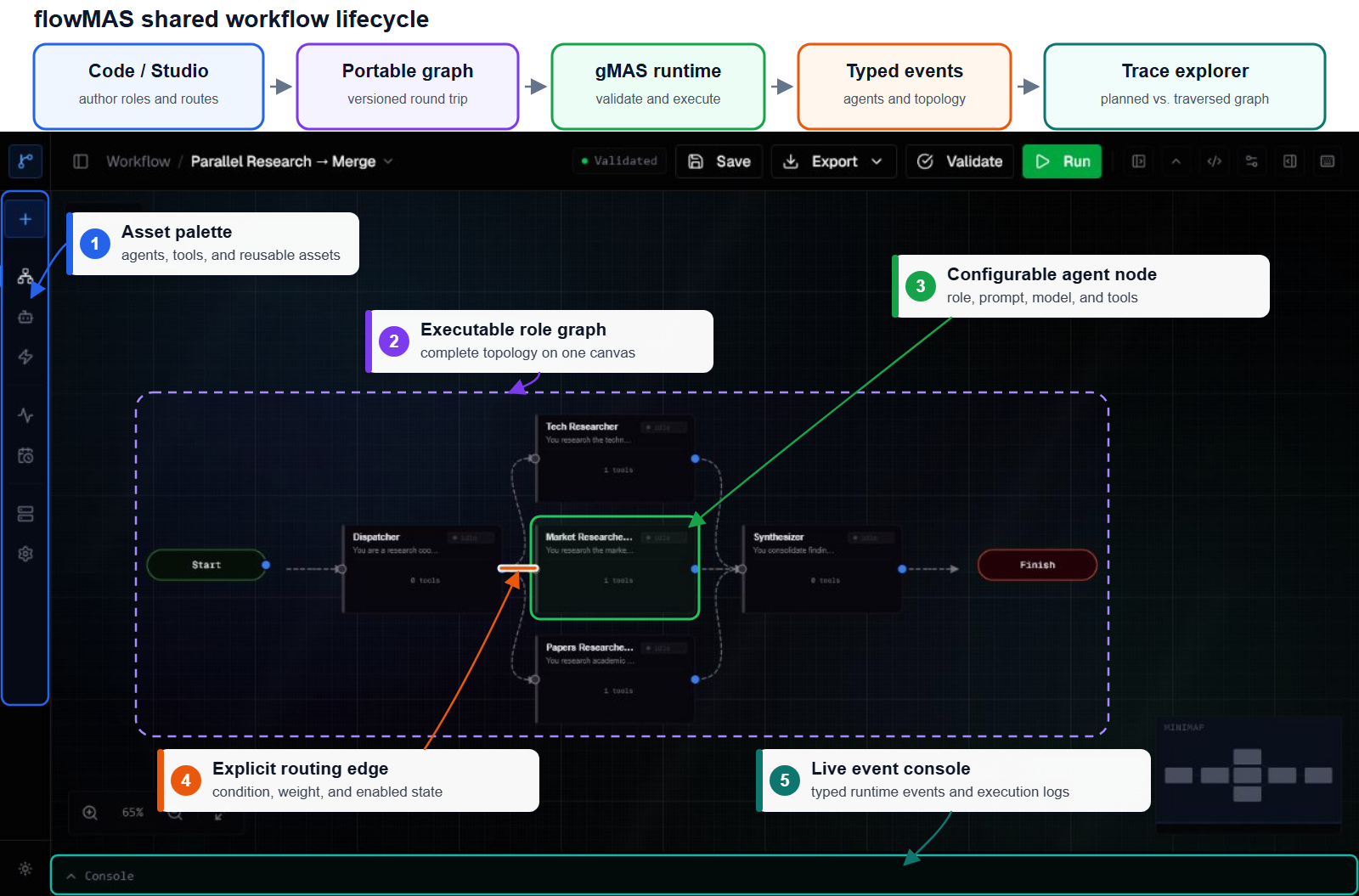
What flowMAS provides
-
Author an executable role graph
Configure agents, prompts, models, tools, routes, conditions, weights, entry points, and exit points on one canvas.
-
Validate against the runtime
Validation materializes the gMAS graph and derives its execution order. It is more than document or schema validation.
-
Inspect the realized workflow
Follow typed lifecycle and topology events, then move from aggregate metrics to traces, agents, model calls, tools, memory activity, and provider usage.
Project boundaries
| Component | Responsibility |
|---|---|
| gMAS | Graph engine, agents, schedulers, tools, and execution semantics |
| flowMAS | Browser studio, persistence, validation API, execution control, and observability integration |
| gMAS Observability | Self-hosted event ingestion, trace reconstruction, metrics, and Trace Explorer |
flowMAS consumes gMAS through a pinned Git submodule. It does not maintain a fork of the runtime.
Start locally
git clone --recurse-submodules https://github.com/frontier-ai-next/flowMAS.git
cd flowMAS
./scripts/dev-up.sh
The development launcher starts the studio on port 3000, the API on 8000,
and Trace Explorer on 8100. See Getting started for
prerequisites, Docker instructions, and troubleshooting.
Read next
- Architecture explains the shared graph boundary and event flow.
- UI guide documents the authoring and run experience.
- Observability covers telemetry, privacy, and deployment controls.
- Evaluation provides complete tables, methodology, and limitations.
- Deployment covers local Compose and production operation.