Architecture
flowMAS preserves one versioned role graph across authoring, execution, and inspection. It does not translate a visual workflow into a separate runtime language.
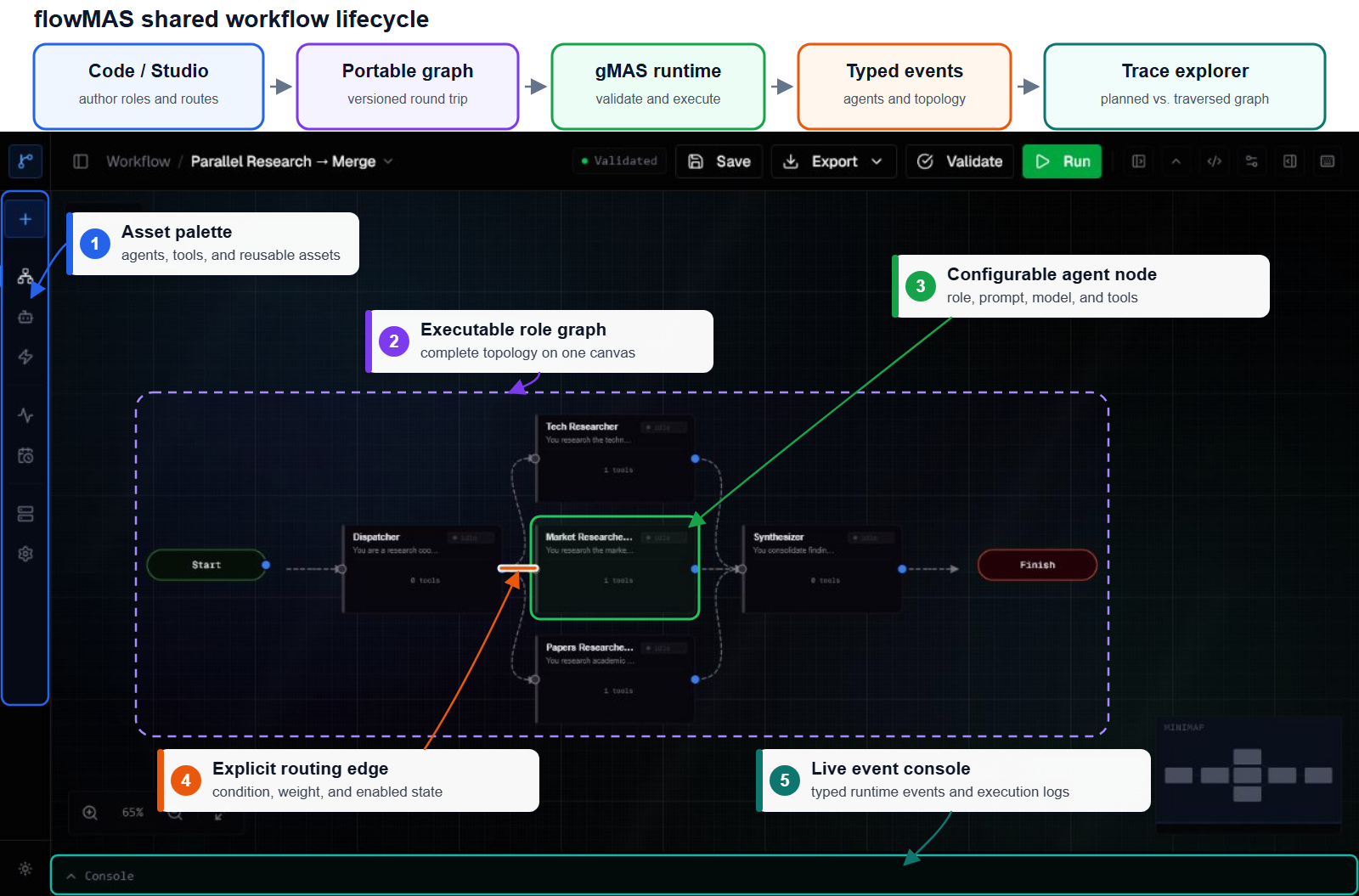
Shared workflow lifecycle
- Code or studio authoring produces a graph document containing agents, executable routes, entry and exit points, run settings, and layout.
- Validation materializes the corresponding gMAS runtime graph and derives an execution order.
- Execution follows the declared plan or uses adaptive controls to evaluate conditional routes, stopping rules, fallbacks, and allowed topology changes.
- Typed events retain run, agent, route, model, tool, memory, retry, budget, and topology context.
- Trace reconstruction joins those events back to the declared graph so an operator can compare planned and traversed structure.
Runtime boundaries
| Layer | Location | Owns |
|---|---|---|
| Studio | apps/web |
Canvas, inspectors, configuration, live feedback, and run navigation |
| Platform API | apps/api |
Persistence, compilation, execution control, sessions, and schedules |
| Runtime | vendor/gmas |
Role graph, agents, schedulers, runner, tools, and graph semantics |
| Observability SDK | packages/gmas-observability |
Redaction, bounded events, asynchronous batching, and callback integration |
| Observability service | apps/observability |
Ingestion, persistence, trace reconstruction, metrics, and Trace Explorer |
The runtime is pinned as a Git submodule. Updating it is an explicit repository change, which keeps a flowMAS release reproducible.
Portable graph document
The graph document is the round-trip boundary between the UI and runtime. It contains:
- agent profiles and model configuration;
- directed routes with condition, weight, and enabled state;
- explicit start, entry, exit, and task targets;
- run settings and routing policy;
- stable identifiers and canvas layout.
Imports from other workflow tools preserve supported topology and layout, but framework-specific execution semantics may require manual reconfiguration. Validation warnings make that boundary explicit.
Execution and adaptation
The fixed scheduler executes the derived plan. Adaptive execution can evaluate conditional paths, stop work early, bypass disabled or unreachable nodes, and apply controlled topology updates. The declared graph remains separate from the realized graph for each run.
This separation matters operationally: a final answer alone cannot explain which routes were considered, which agents actually ran, or where latency and provider usage accumulated.
Event and trace flow
gMAS runner
  └─ typed callbacks
       └─ observability SDK queue
            └─ HTTP ingestion
                 └─ SQLite/WAL event store
                      ├─ aggregate metrics
                      ├─ span waterfall
                      └─ planned vs. traversed graph
Delivery is asynchronous and fail-open. Secret-like fields are redacted, strings are bounded, and prompt/output capture can be disabled. See Observability for the complete event and privacy model.
Workspace and persistence model
The public studio uses anonymous session-scoped workspaces. A stable HttpOnly cookie identifies the browser workspace; graphs, agents, schedules, and runs are stored under the configured API data directory. Observability data is stored separately so its retention and backup policy can differ from workflow state.
For production implications, including TLS, stable encryption keys, persistent paths, and the current single-replica scheduler constraint, see Deployment.